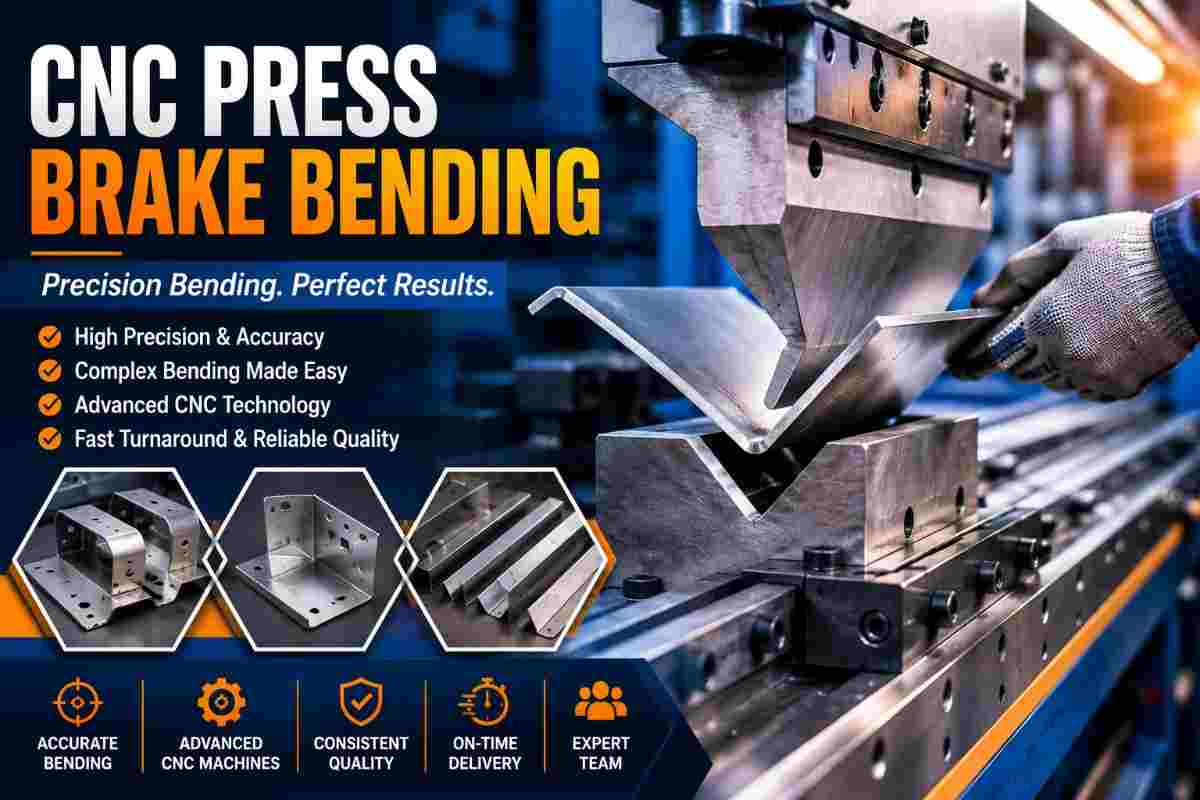
In custom metal fabrication, cutting a part to the right shape is only half the job. The other half is forming it. CNC press brake bending is the process that takes flat laser-cut or sheared metal sheets and forms them into precise three-dimensional profiles such as enclosures, brackets, channels, frames, and assemblies.
For manufacturers and engineers across India, the difference between a manually bent part and a CNC press brake bent part is the difference between inconsistency and repeatability. Between rework and right-first-time production. Virwadia Industries operates CNC press brake equipment to deliver bending results that match your drawings exactly, every time.
WHAT IS CNC PRESS BRAKE BENDING?
A press brake is a machine that bends sheet metal by clamping it between a punch and a die, then applying controlled downward force to form an angle. The CNC element means every movement of the back gauge, ram depth, and beam position is controlled by computer software programmed directly from your drawing.
The key components that define CNC press brake performance are:
- Ram depth control: The CNC system controls exactly how far the punch travels into the die, determining the final bend angle with precision that manual operation simply cannot match.
- Back gauge positioning: The back gauge positions the sheet to the correct distance from the bend line automatically, ensuring consistent flange lengths across every piece in a batch.
- Tonnage calculation: CNC software calculates the exact press force required for the material type, thickness, and bend radius, protecting both the tooling and the workpiece from damage.
- Bend sequencing: Complex multi-bend parts are programmed as sequences, with the machine guiding the operator through each step to prevent errors and tool collisions.
- Crowning compensation: CNC press brakes automatically compensate for bed deflection across long bends, ensuring the angle is consistent from end to end on wide sheets.
HOW CNC PRESS BRAKE BENDING IMPROVES ACCURACY
Accuracy in metal bending depends on three variables: the consistency of the machine, the quality of the program, and the skill of the operator. CNC press brakes address all three systematically.
- Angle repeatability: CNC ram depth control delivers the same bend angle on part one and part one thousand. Manual bending cannot match this level of repeatability across a production run, especially at volume.
- Consistent flange lengths: Automatic back gauge positioning eliminates the measurement errors that are unavoidable when operators manually position sheets for every individual bend.
- Material springback compensation: CNC systems account for the natural springback of different materials and thicknesses, overbending precisely so the finished angle matches the drawing after the material relaxes.
- Program-based quality: Once a bending program is created and verified, it can be recalled for repeat orders instantly. Every future run starts from the same proven parameters with no re-learning required.
- Tolerance capability: CNC press brake bending at Virwadia Industries achieves angular tolerances of plus or minus 0.5 degrees and dimensional tolerances of plus or minus 0.1 mm on standard profiles, meeting the requirements of precision engineering, electrical enclosures, and structural fabrication work.
HOW CNC PRESS BRAKE BENDING IMPROVES PRODUCTION EFFICIENCY
Accuracy alone does not make a fabrication process efficient. CNC press brake bending improves production efficiency across several dimensions that directly affect your cost per part and delivery lead time.
- Faster setup times: CNC programs are loaded in seconds. There is no manual measurement, trial bending, or gauge adjustment between jobs or between operators. Setup time is reduced significantly compared to conventional press brakes.
- Reduced scrap and rework: Because the first part bent to a new program is accurate, scrap from incorrect trial pieces is eliminated. Rework caused by inconsistent manual bending is removed from the production workflow entirely.
- Higher throughput on complex parts: Multi-bend profiles that would require significant operator skill and time when done manually are handled automatically by the CNC sequence program, maintaining speed even on intricate geometries.
- Operator efficiency: One skilled CNC operator can manage bending production that would previously have required multiple experienced manual operators. Labor cost per part decreases without any sacrifice in quality.
- Repeatable batch production: Stored programs mean repeat orders are set up and running within minutes. There is no re-testing for familiar parts, which benefits clients who place regular orders throughout the year.
- Integration with laser cutting: At Virwadia Industries, laser-cut parts flow directly to the press brake stage. Because laser cutting and CNC bending are both driven from the same drawing file, dimensional consistency is maintained through the entire fabrication process.
MATERIALS WE BEND
Virwadia Industries handles a wide range of materials on CNC press brake equipment:
- Mild steel up to 12 mm thickness
- Stainless steel up to 8 mm thickness
- Aluminium up to 10 mm thickness
- Galvanized and pre-coated steel
- Brass and copper sheet
- Perforated and checkered plate
COMMON APPLICATIONS
CNC press brake bent components are used across a broad range of industries and products:
- Electrical enclosures and control panels
- Equipment cabinets and machine frames
- Structural brackets and channel sections
- Automotive body and trim components
- Furniture and display unit frames
- Architectural cladding and facade profiles
- HVAC ducting and support structures
- Medical and pharmaceutical equipment housings
WHY VIRWADIA INDUSTRIES FOR CNC PRESS BRAKE BENDING?
Virwadia Industries combines advanced CNC press brake equipment with deep fabrication expertise to deliver bending results that meet drawing requirements without compromise.
- High-capacity machines: Press brake capacity up to 160 tonnes and bend lengths up to 3 metres, covering the full range of standard sheet fabrication requirements.
- Integrated laser and bending service: Laser cutting and press brake bending under one roof means tighter control over dimensional consistency and faster overall lead times for complete fabricated parts.
- Design for manufacture support: The engineering team reviews your drawings before bending begins, identifying any features that could cause forming problems and suggesting practical modifications that preserve your design intent.
- Flexible quantities: From single prototype parts to high-volume production batches, there is no minimum order restriction at Virwadia Industries.
- Quality inspection: Every bent part is checked against the drawing before dispatch. Non-conforming parts are re-formed or replaced before the order ships.
- Pan-India delivery: Fully fabricated parts are packed securely and delivered to clients across all major manufacturing cities in India with shipment tracking on every order.
CONCLUSION
CNC press brake bending is not simply a step in the fabrication process. It is the step that determines whether your finished parts fit, function, and arrive ready for assembly without rework. The accuracy and efficiency advantages of CNC control over manual bending are measurable and significant, from tighter tolerances and consistent flange lengths to faster setups and lower scrap rates.
Virwadia Industries brings this technology together with experienced engineering support and integrated fabrication services to deliver bent metal components that meet your specifications the first time, every time.
To get a free quote for CNC press brake bending, visit virwadiaindustries.com or contact the team directly through the website.
About Virwadia Industries: A leading custom metal fabrication company in India offering CNC fiber laser cutting, CNC press brake bending, welding, and surface finishing services to clients across automotive, electrical, construction, and general engineering sectors.