
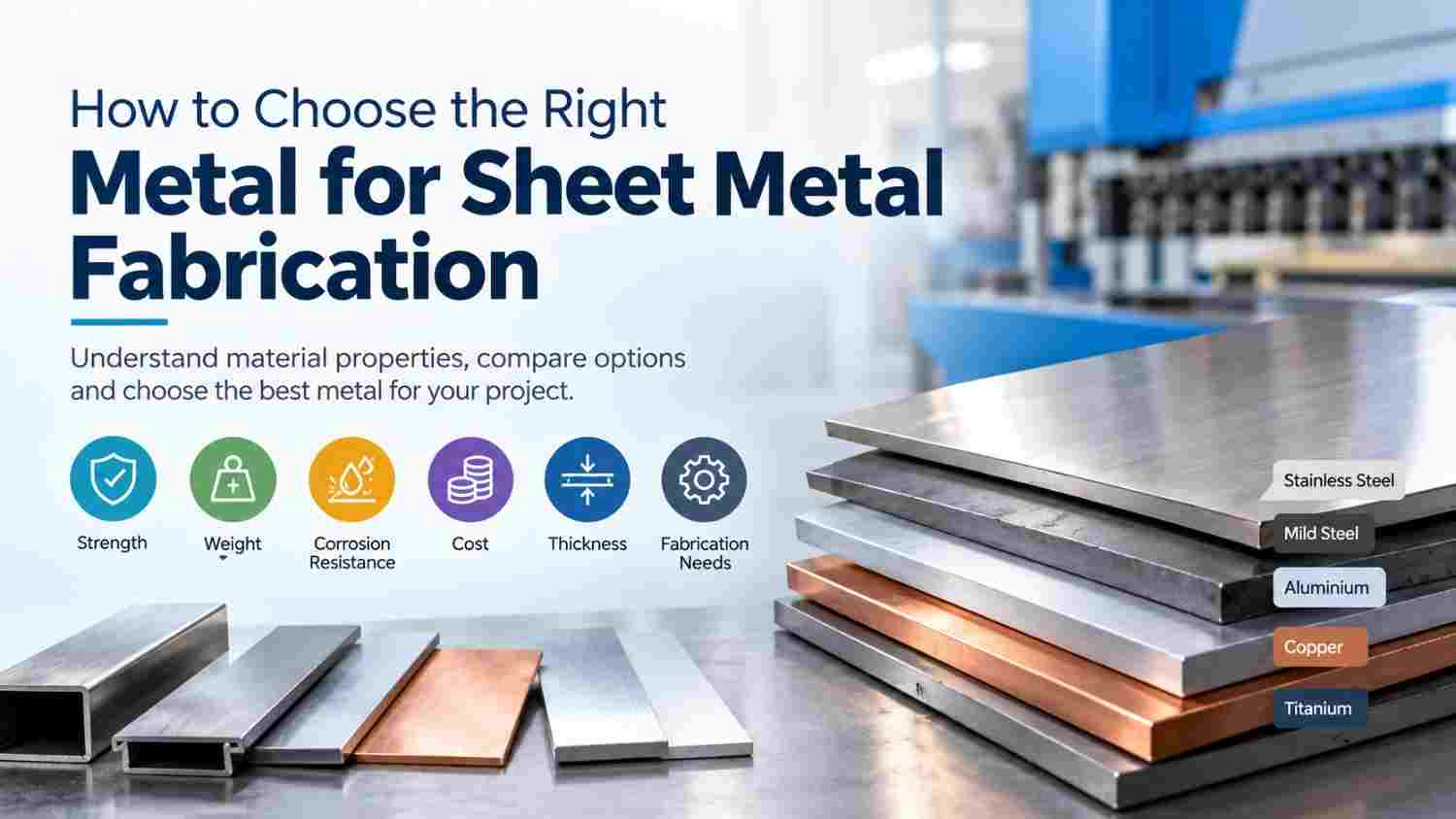
Choosing the right metal is one of the most important decisions in sheet metal fabrication. The material affects the component’s strength, weight, corrosion resistance, appearance, machinability, weldability, cost, and service life.
Stainless steel, mild steel, aluminium, copper, and titanium all have different properties. The right choice depends on what the component needs to withstand, how it will be fabricated, and where it will be used.
Understanding these differences before production can help avoid unnecessary material costs and ensure that the finished component performs as expected.
There is no single metal that is best for every sheet metal fabrication project. The most suitable material depends on the application, required strength, weight, corrosion resistance, fabrication method, and operating environment.
Common choices include:
The material should therefore be selected based on the requirements of the finished component rather than simply choosing the strongest or most expensive option.
Several technical and practical factors should be considered before selecting a sheet metal material.
The most important factors include:
For example, a lightweight enclosure may require a different material from a heavy-duty industrial bracket. Similarly, an electrical component may have conductivity requirements that make copper more suitable than other metals.
Stainless steel is a popular choice when corrosion resistance, durability, and appearance are important.
It can be fabricated through processes such as cutting, bending, welding, and finishing. Stainless steel is available in different grades, each with its own combination of corrosion resistance, strength, temperature performance, and fabrication characteristics.
It is commonly considered for:
One of the main advantages of stainless steel is its resistance to corrosion. However, the specific grade should be selected according to the environment and performance requirements.
Mild steel is often used when a combination of strength, versatility, availability, and economical fabrication is required.
It can generally be cut, bent, welded, and fabricated using commonly available manufacturing processes. This makes it suitable for many general industrial applications.
Mild steel may be considered for:
When corrosion resistance is required, additional surface protection or coating may be considered depending on the application.
Aluminium is not universally better than stainless steel. Each material has advantages that make it suitable for different applications.
Aluminium is significantly lighter than stainless steel, making it useful where reducing component weight is important. It also offers good corrosion resistance and can be fabricated into a variety of components.
Stainless steel, on the other hand, is generally selected when higher strength, durability, corrosion resistance, or a particular surface appearance is required.
Aluminium may be preferred when:
Stainless steel may be preferred when:
The better material depends on the specific application rather than the material name alone.
Aluminium is valued primarily for its low density, corrosion resistance, and versatility.
Its lower weight can make fabricated components easier to handle and can reduce the overall weight of an assembly. Aluminium can also be cut, bent, welded, and fabricated using appropriate processes.
It is commonly used for:
However, aluminium behaves differently from steel during cutting, bending, and welding. The alloy, thickness, tooling, and fabrication method should therefore be considered before production.
Copper is mainly selected when excellent electrical or thermal conductivity is required.
Unlike materials chosen primarily for structural strength, copper often plays an important role in electrical and power applications because of its ability to conduct electricity efficiently.
Copper sheet fabrication can be used for:
Because copper has different material characteristics from steel and aluminium, cutting, bending, and welding parameters need to be selected appropriately.
Titanium is generally considered when a combination of high strength, low density, and excellent corrosion resistance is required.
It can provide a useful strength-to-weight ratio and can perform well in demanding environments. However, titanium typically requires more specialized fabrication considerations than common materials such as mild steel or aluminium.
Titanium may be used for:
Its higher material and processing requirements mean that titanium is normally selected when its specific properties provide a meaningful advantage for the application.
The five materials have different strengths and typical uses.
Stainless steel offers good corrosion resistance and durability and is suitable for equipment, enclosures, panels, and applications where environmental resistance matters.
Mild steel is a versatile option for general fabrication, structural components, brackets, frames, and industrial assemblies.
Aluminium is useful when low weight, corrosion resistance, and easy handling are important considerations.
Copper is particularly valuable for electrical and thermal applications because of its excellent conductivity.
Titanium is considered for demanding applications where high strength, low density, and corrosion resistance are important.
The best choice depends on the combination of properties required by the final component.
Yes. Material thickness can significantly affect how a sheet behaves during cutting, bending, welding, and forming.
A material that performs well at one thickness may require different fabrication parameters at another thickness. Thickness also affects component weight, rigidity, bend radius, heat input during welding, and overall structural performance.
Before production, both the material grade and sheet thickness should therefore be specified clearly.
Strength is important when a component needs to support loads, resist deformation, withstand impact, or maintain its shape during operation.
However, maximum strength is not always the primary requirement. A component may instead need a balance of strength, weight, corrosion resistance, flexibility, conductivity, and fabrication suitability.
For example, choosing a very strong material for a lightweight component may increase material and processing costs without providing a meaningful benefit.
The required strength should therefore be evaluated alongside the other properties needed by the application.
Corrosion resistance becomes particularly important when fabricated components are exposed to moisture, chemicals, outdoor conditions, or other corrosive environments.
Stainless steel and aluminium can offer useful corrosion resistance, while titanium provides excellent corrosion resistance in demanding environments.
Mild steel can also be used in environments where appropriate protective coatings or surface treatments are provided.
The expected operating environment should always be considered when selecting the material.
Yes. The chosen fabrication process can influence which material is most practical for a particular component.
Different metals respond differently to:
For example, aluminium and copper have different thermal characteristics from steel, which can affect cutting and welding parameters. Titanium may require more controlled processing conditions because of its material characteristics.
This is why material selection and process planning should be considered together.
Weight can be a major consideration when fabricated components need to be moved, installed, transported, or incorporated into a lightweight assembly.
Aluminium is often considered when weight reduction is important because it has a lower density than steel.
Titanium can also provide a strong strength-to-weight ratio, although its cost and processing requirements are generally higher.
For applications where weight is less important than durability or structural performance, steel may be a more appropriate option.
Material cost is an important consideration, but the lowest material price does not always result in the lowest overall project cost.
The total cost can also include:
A material that costs more initially may provide better durability or reduce maintenance requirements in a particular application.
The best approach is to consider the total manufacturing and service requirements rather than comparing material prices alone.
The selection process should begin by defining what the finished component needs to do.
Consider the following questions:
Once these requirements are established, suitable materials can be compared based on their performance and fabrication requirements.
No. Although many metals can undergo similar fabrication operations, the exact parameters and techniques can vary considerably.
Cutting speed, laser settings, tooling, bend allowance, welding parameters, heat input, and finishing requirements may all change according to the material.
For this reason, experienced fabrication planning is important when working with different sheet metals.
The best approach is to balance performance, fabrication requirements, application, and cost.
Instead of asking only which metal is strongest or cheapest, consider the complete service requirement of the component.
For general fabrication, mild steel may provide a practical combination of strength and versatility. Stainless steel can be suitable where corrosion resistance is important. Aluminium is useful where low weight is a priority. Copper is particularly valuable for electrical and thermal applications, while titanium can be considered for specialized applications requiring its unique combination of properties.
Selecting the right material at the beginning can help improve component performance, simplify fabrication, and avoid unnecessary manufacturing costs.
Choosing the right metal for sheet metal fabrication requires more than comparing material strength or price. Stainless steel, mild steel, aluminium, copper, and titanium each offer different combinations of strength, weight, corrosion resistance, conductivity, weldability, and fabrication characteristics.
The right choice depends on the component's design, operating environment, manufacturing process, required performance, and budget.
By evaluating these factors before cutting, bending, welding, and finishing begin, manufacturers can select a material that is appropriate for both the fabrication process and the final application.