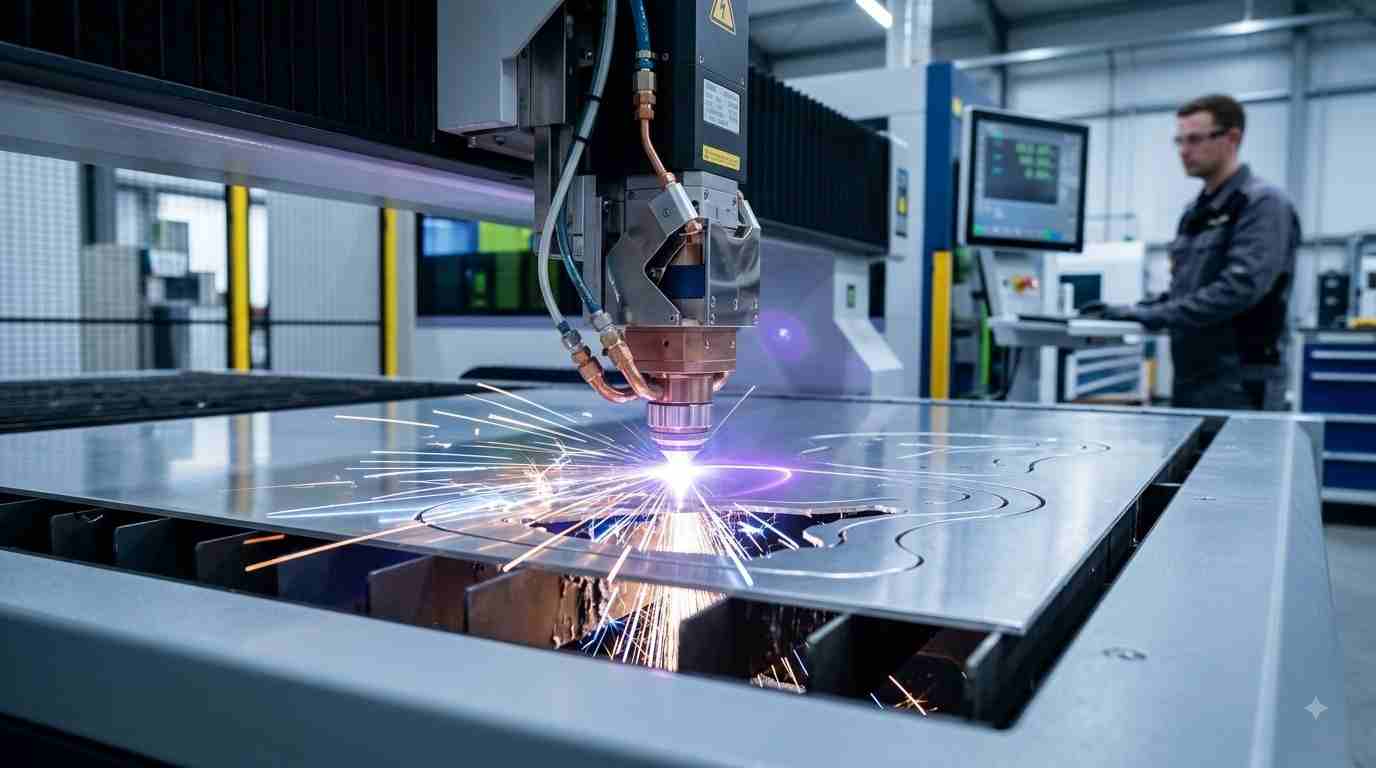
Aluminum sheet metal is widely specified across aerospace, automotive, electronics, and structural manufacturing due to its lightweight nature, exceptional strength-to-weight ratio, and natural corrosion resistance. However, processing aluminum via traditional thermal cutting methods presents unique metallurgical challenges. Overcoming reflectivity, preventing heat-induced warping, and eliminating edge burrs requires advanced fiber laser technology combined with optimized processing parameters.
Aluminum possesses physical properties that complicate laser cutting when compared to ferrous metals like carbon steel:
High Optical Reflectivity: Raw aluminum surfaces reflect a significant portion of light energy, especially in the infrared spectrum used by older $ ext{CO}_2$ lasers.
High Thermal Conductivity: Aluminum dissipates heat rapidly away from the cutting zone across the entire sheet, requiring higher energy density to maintain a continuous melt pool.
Low Melting Point with High Fluidity: Molten aluminum tends to adhere to the underside of the cut edge, creating stubborn burrs (dross) if gas pressure and feed rates are not precisely calibrated.
Legacy $ ext{CO}_2$ laser systems struggled with aluminum because reflected laser light could travel backward into the resonator, causing severe optical damage.
Modern fiber lasers operate at a wavelength of approximately $1.07 mu ext{m}$—one-tenth that of a $ ext{CO}_2$ laser. Aluminum absorbs this wavelength much more efficiently, drastically reducing back-reflection risk during initial beam penetration. Advanced fiber laser heads also feature built-in optical isolators and back-reflection sensors that protect internal optical components while delivering focused energy directly into the aluminum sheet.
Achieving clean, burr-free edge profiles on aluminum sheets depends heavily on assist gas selection:
High-Pressure Nitrogen: Used for critical structural and cosmetic parts. Nitrogen acts as a high-velocity mechanical agent that ejects molten metal without reacting chemically with the aluminum. This produces a smooth, burr-free, unoxidized edge that is immediately ready for anodizing or precision welding.
Filtered Compressed Air: An economical alternative for non-cosmetic or hidden structural components. While air contains oxygen—which creates a mild, thin oxide layer along the edge—it delivers high cutting speeds on thin-gauge aluminum sheets.
Different aluminum alloys require customized laser parameter profiles to achieve optimal edge squareness and surface finish:
5052 Aluminum (Non-Heat Treatable): Highly ductile and widely used for sheet metal enclosures. Its chemical composition allows rapid cutting speeds with exceptional edge smoothness.
6061-T6 Aluminum (Structural Grade): Formulated with magnesium and silicon. Requires precise focal position tuning to prevent micro-dross formation along the bottom rim of thicker sheets.
7075 Aluminum (Aerospace Grade): High-strength alloy containing zinc. Demands high laser power and precise heat control to avoid micro-cracking along the cut boundary.
Choosing an experienced fabrication partner for custom aluminium sheet metal cutting services for lightweight components guarantees burr-free edge quality, strict dimensional accuracy, and optimal material utilization.