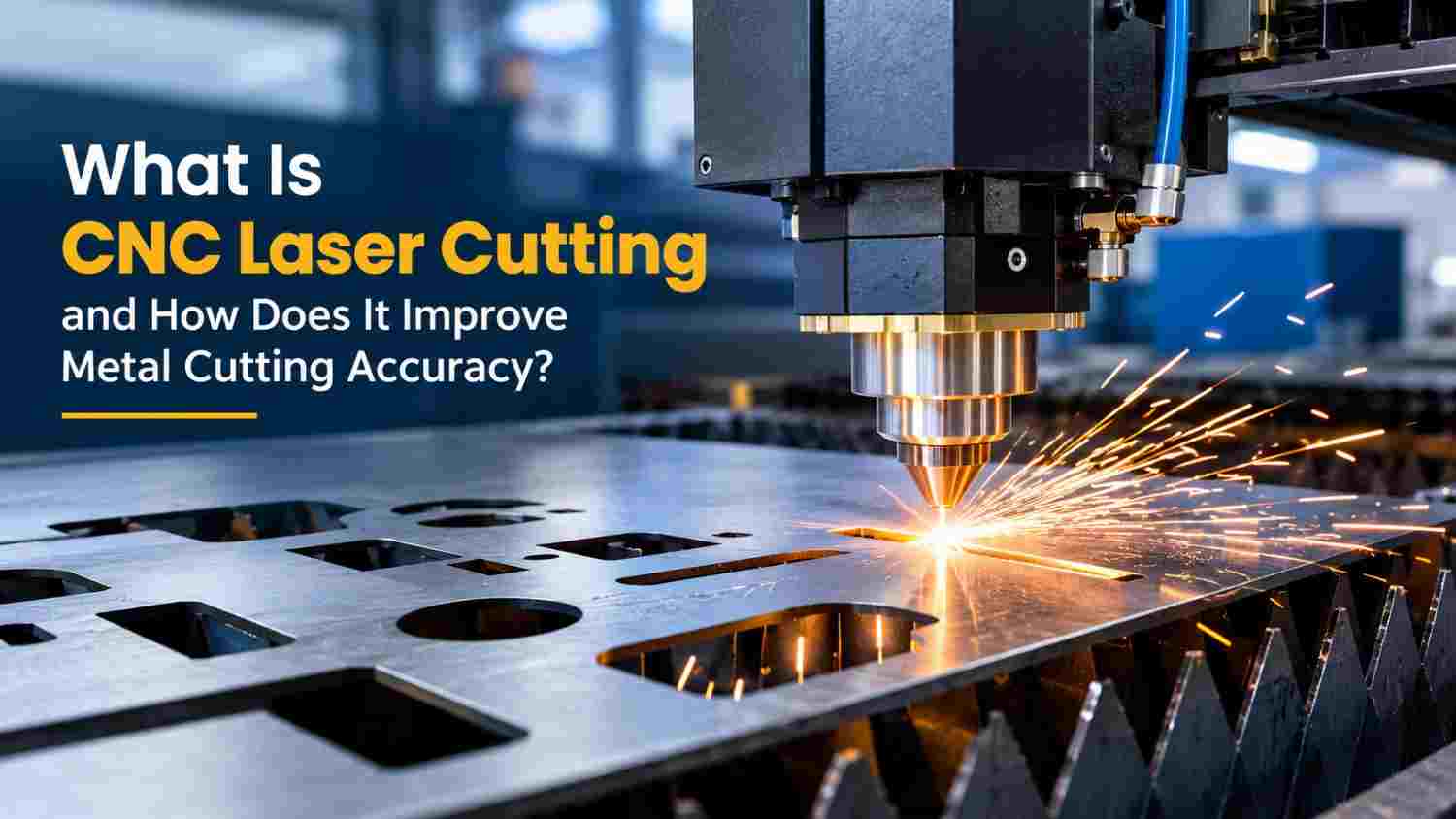
CNC laser cutting is a computer-controlled manufacturing process used to cut metal sheets into precise shapes and profiles. It uses a focused laser beam to heat, melt, or vaporize material along a programmed cutting path.
The process is widely used for components that require accurate dimensions, clean profiles, detailed cutouts, and repeatable results. Depending on the material and thickness, CNC laser cutting can be used for stainless steel, mild steel, aluminium, copper, titanium, and other suitable metals.
CNC laser cutting is a manufacturing process in which a computer-controlled machine directs a concentrated laser beam along a predefined path to cut a metal sheet.
The cutting instructions are usually generated from a digital CAD drawing. The CNC system controls the movement of the cutting head according to the programmed geometry.
The process can produce:
Because the cutting path is controlled digitally, the same design can be reproduced across multiple components with a high degree of consistency.
CNC laser cutting generally follows a sequence of design preparation, machine setup, material positioning, cutting, and inspection.
The required component is first created or prepared as a digital drawing. The dimensions, holes, profiles, and other geometric details are defined in the design.
The design is then converted into instructions that the CNC machine can interpret.
The selected metal sheet is positioned on the machine bed. The material type and thickness are considered when determining the appropriate cutting parameters.
The laser system generates a concentrated beam of energy. The beam is directed through the cutting head and focused onto a small area of the metal surface.
The focused laser generates enough heat to melt or vaporize the material along the programmed path.
An assist gas may be used to help remove molten material from the cut zone and support the cutting process.
The cutting head moves according to the programmed geometry. This allows the machine to follow straight lines, curves, holes, slots, and complex profiles accurately.
After cutting, the finished component can be inspected to verify dimensions, cut quality, hole sizes, and other project-specific requirements.
CNC laser cutting can improve cutting accuracy by combining computer-controlled movement with a highly concentrated cutting beam.
Traditional manual cutting methods can depend heavily on operator technique and physical measurement. CNC systems, in contrast, follow programmed digital geometry.
Accuracy can be influenced by several factors, including:
Therefore, laser cutting should not be viewed as having one fixed accuracy level for every material and thickness.
Laser cutting can achieve very high dimensional accuracy, but the actual result depends on the machine, material, thickness, geometry, and processing conditions.
For precision components, manufacturers may work to tight dimensional tolerances when the equipment and process are properly configured.
Factors that can influence the final accuracy include:
For this reason, a required tolerance should be specified as part of the component drawing rather than assuming that every laser-cut part will automatically have the same tolerance.
Repeatability means the ability to produce multiple components with consistent dimensions and geometry.
This is particularly important when a project requires dozens, hundreds, or thousands of similar components.
Once the cutting program and appropriate parameters have been established, the CNC machine can follow the same digital cutting path for subsequent parts.
This can help maintain consistency in:
Repeatability is especially valuable when laser-cut components need to fit together during later bending, welding, or assembly operations.
CNC laser cutting can be used with several common industrial metals, although the suitable material range depends on the laser system, equipment configuration, and material thickness.
Commonly processed materials include:
Different metals respond differently to laser energy because they have different thermal and optical properties.
For example, copper and aluminium have high thermal conductivity and can require different processing parameters from mild steel or stainless steel.
Yes, stainless steel can be laser cut using suitable equipment and processing parameters.
Laser cutting can create accurate profiles, holes, slots, and other features in stainless steel sheet.
The appropriate parameters depend on:
Stainless steel laser cutting is commonly considered for enclosures, panels, brackets, equipment components, and precision fabricated parts.
Yes, mild steel is widely processed using CNC laser cutting.
It is suitable for many general industrial components because it can be cut into complex profiles while maintaining consistent dimensions.
Typical applications include:
The cutting parameters need to be adjusted according to the sheet thickness and required cut quality.
Yes, aluminium can be laser cut with appropriately configured equipment.
Because aluminium has high thermal conductivity and reflective characteristics, cutting parameters need to be selected carefully.
Laser-cut aluminium can be used for:
The aluminium alloy and sheet thickness should be considered when planning the cutting process.
Copper can be laser cut, but it presents different processing requirements from materials such as mild steel.
Copper has high thermal and electrical conductivity and can reflect certain laser wavelengths. These characteristics can affect how efficiently laser energy is absorbed.
Modern laser systems designed for processing reflective metals can be used for suitable copper applications.
Copper laser cutting can be relevant to electrical components, conductive parts, busbars, and other precision applications.
Titanium can be laser cut when the equipment and processing conditions are appropriate for the material.
Because titanium is used in demanding applications, maintaining suitable heat control and cut quality can be important.
The laser parameters should be selected according to the titanium grade, thickness, component geometry, and required finish.
One of the main advantages of CNC laser cutting is its ability to produce both simple and complex two-dimensional profiles.
It can create:
The geometry is controlled through the digital cutting program, allowing designs that may be difficult or time-consuming to reproduce manually.
CNC laser cutting offers several manufacturing advantages when the process is properly matched to the application.
The focused laser beam can produce detailed profiles and small features with controlled cutting paths.
Digital CNC control allows the same cutting program to be repeated across multiple components.
Laser cutting can produce intricate profiles, holes, slots, and internal cutouts without requiring separate manual cutting operations.
Once the machine is correctly programmed and set up, much of the cutting operation can be controlled automatically.
Parts can often be arranged closely on a sheet through suitable nesting strategies, helping reduce unused material.
The digital nature of CNC cutting makes it useful for both one-off components and repeated production requirements.
Laser cutting is highly useful, but it is not suitable for every manufacturing requirement.
Some limitations include:
The most suitable cutting method should therefore be selected according to material, thickness, geometry, tolerance, quantity, and final application.
Yes. Laser cutting uses concentrated heat, so a heat-affected zone can occur near the cutting edge.
The size and effect of the heat-affected area depend on factors such as:
Properly controlled laser cutting can minimize unwanted thermal effects, but heat should always be considered when working with temperature-sensitive materials or precision components.
For applications requiring complex profiles, precision, and repeatability, CNC laser cutting can provide advantages over manual cutting methods.
Manual cutting can be suitable for simple tasks, repairs, or situations where extremely high precision is not required. CNC laser cutting becomes more useful when a project requires consistent dimensions, detailed geometries, or multiple identical components.
The appropriate method depends on the specific production requirements.
Yes. CNC laser cutting can be useful for prototyping because digital designs can be converted into physical components without requiring extensive manual tooling.
A prototype can be cut, inspected, tested, and modified before the final production design is established.
This can be useful when developing:
Design changes can then be incorporated into the digital file before another set of components is produced.
CNC laser cutting is used across many industries where accurate sheet metal components are required.
Common applications include:
The exact application depends on the material, component design, required tolerance, and production requirements.
Before sending a component for laser cutting, several factors should be confirmed.
These include:
Providing clear drawings and material specifications helps the cutting process be planned correctly.
CNC laser cutting is often only one stage of a larger fabrication process.
A typical component may follow a workflow such as:
CAD Design → Laser Cutting → Bending → Welding → Finishing → Inspection
For example, a sheet can first be laser cut into a precise flat pattern. The cut component can then undergo CNC press brake bending to create the required angles or flanges. Additional pieces may be joined through welding before final finishing and inspection.
This allows laser cutting to work as part of a complete manufacturing process rather than as an isolated operation.
The combination of digital programming, controlled machine movement, and a concentrated laser beam makes CNC laser cutting suitable for many precision sheet metal applications.
The process can reproduce complex geometries consistently while reducing the need for manual measurement and cutting.
However, precision ultimately depends on the complete manufacturing system. Machine condition, material quality, programming, setup, cutting parameters, inspection, and operator expertise all contribute to the final result.
CNC laser cutting is a computer-controlled process that uses a focused laser beam to cut metal sheets into precise profiles and components. It can provide accuracy, repeatability, complex geometries, and consistent production when the material and process are properly selected.
Stainless steel, mild steel, aluminium, copper, and titanium can all be suitable for laser cutting under appropriate conditions, although each material requires its own processing considerations.
The actual cutting accuracy depends on equipment capability, material type, thickness, geometry, machine calibration, and cutting parameters. For this reason, laser cutting should always be planned around the specific requirements of the component rather than relying on a generic accuracy specification.