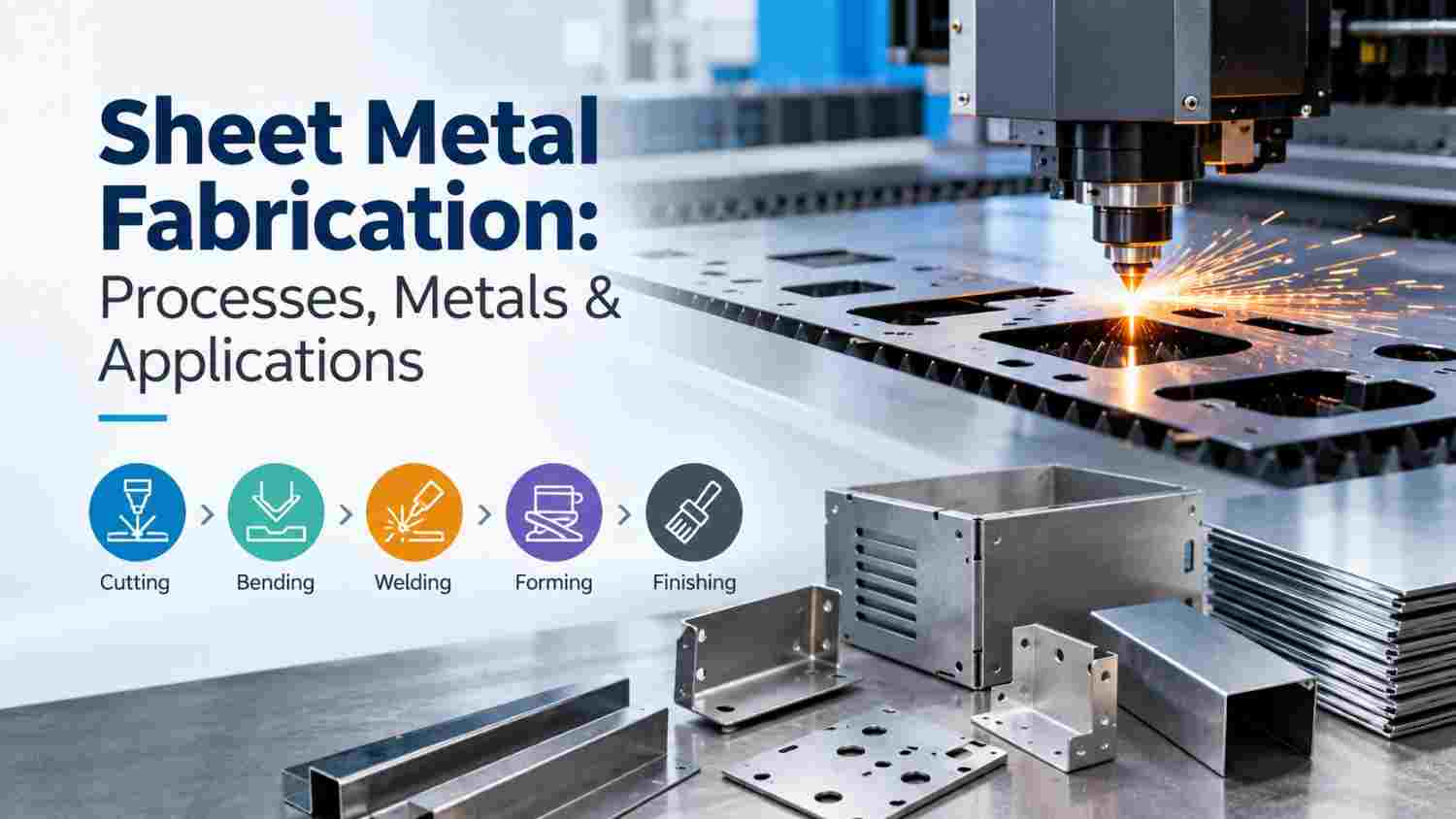
Sheet metal fabrication is a manufacturing process used to convert flat metal sheets into functional components, structures, panels, enclosures, brackets, assemblies, and other precision parts. It can involve several operations, including cutting, bending, welding, forming, and finishing.
The exact fabrication process depends on the metal being used, required dimensions, component design, thickness, strength requirements, surface finish, and final application. Modern fabrication can combine CNC machines, laser cutting equipment, press brakes, and different welding technologies to produce accurate and repeatable components.
Sheet metal fabrication is the process of manufacturing products and components from metal sheets by cutting, bending, joining, and finishing them according to a specific design.
Unlike processes that start with a solid block of metal, sheet metal fabrication generally works with relatively thin sheets that are shaped into the required form. The finished components can be used in industrial machinery, electrical enclosures, equipment panels, automotive components, architectural products, and many other applications.
A typical fabrication project may involve several stages:
Each stage contributes to the accuracy, strength, appearance, and functionality of the final component.
The main sheet metal fabrication processes include cutting, bending, welding, forming, joining, and finishing.
Different projects require different combinations of these processes. A simple flat component may only need cutting and finishing, while a complex enclosure may require cutting, bending, welding, grinding, and surface treatment.
Sheet metal cutting is generally one of the first fabrication operations. It involves separating the required shape or profile from a larger sheet.
CNC laser cutting is commonly used when manufacturers need accurate profiles, intricate shapes, holes, slots, and repeatable dimensions. The cutting method can be selected according to material type, thickness, component geometry, and production requirements.
Sheet Metal Cutting can be used for manufacturing:
For applications requiring different material characteristics, specialized cutting processes may be selected for stainless steel, mild steel, aluminium, copper, or titanium.
After cutting, a sheet may need to be bent into a specific shape. Bending changes the geometry of the sheet without removing material.
CNC press brake machines are commonly used for controlled and repeatable bending. The machine applies force along a predetermined bend line to create angles, channels, flanges, boxes, and other profiles.
Metal Sheet Bending is frequently used for:
The bend angle, material thickness, tooling, bend radius, and material properties all need to be considered when planning the operation.
Sheet metal cutting removes or separates material, bending changes the shape of the sheet, and welding joins two or more metal parts together.
These processes perform different functions but are often used together during fabrication.
Cutting creates the required individual shapes or profiles.
Bending converts flat pieces into three-dimensional shapes or specific angles.
Welding joins separate pieces or fabricated sections to create a stronger assembly.
For example, consider the fabrication of a metal enclosure. A sheet may first be cut into the required dimensions, then bent to create its sides and flanges. Additional components may then be welded to the enclosure before the finished product receives its required surface treatment.
This combination allows manufacturers to produce complex components from relatively simple sheet materials.
CNC laser cutting uses computer-controlled equipment to cut metal according to a digital design.
The process is useful when components require precise profiles, repeatable dimensions, detailed cutouts, or complex geometries. Because the cutting path is controlled digitally, the same design can be reproduced consistently across multiple components.
Laser cutting can be suitable for materials such as:
The appropriate cutting parameters depend on factors such as material type, sheet thickness, required accuracy, component geometry, and production volume.
Bending allows a flat sheet to become a functional three-dimensional component.
A flat piece of metal may have limited structural or functional value until it is shaped into the required profile. Bending can create flanges, channels, angles, folds, and other features needed for assembly.
For example, a flat sheet can be cut and then bent to form the sides of an enclosure. Similarly, a bracket can be cut to its required outline and then bent to create the angle needed for mounting.
CNC-controlled bending also helps maintain consistency when multiple components need to have the same dimensions and bend angles.
Several welding methods can be used in sheet metal fabrication, including TIG, MIG, ARC, and laser welding.
The appropriate method depends on the material, thickness, joint design, required appearance, production requirements, and application.
TIG welding is often selected when precise control and a clean weld are important. It can be useful for stainless steel, aluminium, and other materials where weld appearance and control are important.
MIG welding is widely used for joining metal components efficiently. It can be suitable for a range of fabrication applications and is often selected for projects requiring productive and consistent welding.
ARC welding uses an electric arc to generate the heat required for joining metal. It is used across various fabrication and industrial applications where suitable equipment and welding procedures are available.
Laser welding uses a concentrated laser beam to create a weld with high precision. It can be particularly useful for applications requiring controlled heat input, accurate joints, and a clean finished appearance.
The selection of a welding process should be based on the actual requirements of the component rather than choosing one method for every application.
Common metals used in sheet metal fabrication include stainless steel, mild steel, aluminium, copper, and titanium.
Each material has different mechanical, thermal, corrosion-resistance, weight, and fabrication characteristics.
Stainless steel is known for its corrosion resistance, durability, and clean appearance. It is widely used for equipment, enclosures, industrial components, architectural products, and applications where resistance to environmental conditions is important.
Mild steel is commonly used for general fabrication because of its availability, strength, and versatility. It can be cut, bent, welded, and finished for a wide range of industrial applications.
Aluminium is lightweight and has good corrosion resistance. Its lower weight makes it useful where reducing component weight is an important consideration.
Copper offers excellent electrical and thermal conductivity. It is therefore commonly associated with electrical and power-related fabrication applications, including busbars and electrical components.
Titanium combines high strength with relatively low density and excellent corrosion resistance. It is used in applications where these properties justify the additional material and processing requirements.
The right metal depends on the functional requirements of the finished component.
Important factors include:
For example, aluminium may be considered when low weight is important, while stainless steel may be selected when corrosion resistance and durability are key considerations.
There is no single material that is suitable for every fabrication application. The selection should be based on the environment in which the component will operate and the performance expected from it.
After the primary fabrication operations are completed, components may go through finishing and inspection processes.
Finishing requirements depend on the application and may include processes such as grinding, deburring, cleaning, polishing, coating, or other surface treatments.
These operations can improve the appearance, remove sharp edges, prepare the surface for further treatment, and help achieve the required final specifications.
Inspection may also be performed to verify dimensions, bend angles, weld quality, surface condition, and other project-specific requirements.
Sheet metal fabrication is used across a wide range of industries because metal sheets can be converted into both simple and complex components.
Common applications include:
The combination of CNC cutting, precision bending, fabrication, and welding makes it possible to manufacture components according to specific designs and dimensional requirements.
Precision is important because fabricated components often need to fit with other parts during assembly.
Even small dimensional variations can affect hole alignment, bend angles, joint positioning, component fit, and overall assembly quality.
Computer-controlled cutting and bending equipment can help manufacturers achieve repeatable dimensions, while appropriate welding procedures help maintain consistent joints.
For complex components, accurate drawings, correct material selection, suitable tooling, controlled processing, and inspection all contribute to the final result.
A fabrication process should be planned according to the component design, material, thickness, tolerances, production quantity, and final application.
A typical workflow may look like this:
Design → Material Selection → Cutting → Bending → Welding/Fabrication → Finishing → Inspection
Not every project requires every stage. Some components may only require cutting, while others may require multiple fabrication and welding operations.
Good process planning helps reduce material waste, maintain dimensional accuracy, simplify assembly, and achieve the required component quality.
Before production begins, several technical factors should be clearly defined.
These include:
A clear drawing or CAD design can also help ensure that the manufacturing process is properly planned before production starts.
Sheet metal fabrication combines several manufacturing processes to transform metal sheets into accurate, functional components. Cutting creates the required profiles, bending shapes the material, welding joins individual parts, and finishing prepares the component for its final application.
The choice of material and fabrication process depends on factors such as strength, weight, corrosion resistance, thickness, design, accuracy, and operating environment.
By understanding how cutting, bending, welding, and finishing work together, businesses can make better decisions when developing custom metal components and fabricated assemblies.