
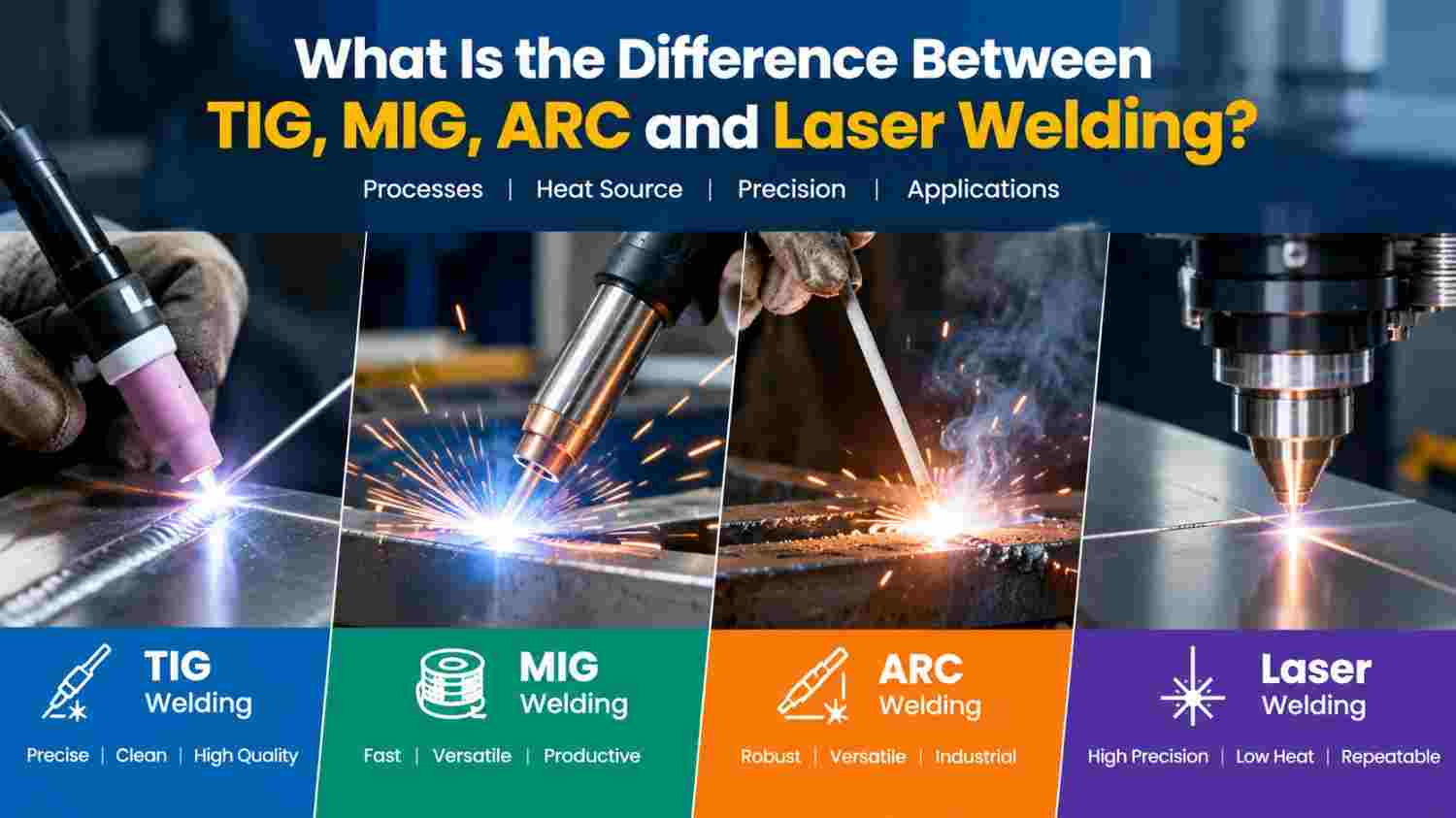
TIG, MIG, ARC, and laser welding are different methods of joining metal components. Each process uses a different heat source, electrode or filler arrangement, and operating technique.
The right welding process depends on factors such as the metal type, material thickness, joint design, required weld appearance, production volume, precision, accessibility, and application.
TIG welding is often associated with precise and controlled welds, MIG welding with productive and versatile fabrication, ARC welding with a broad range of industrial applications, and laser welding with concentrated heat input and precision. However, none of these processes is automatically suitable for every project.
The primary difference is how each process generates and controls the heat required to join the metal.
TIG welding uses a non-consumable tungsten electrode and can provide precise control over the welding arc.
MIG welding uses a continuously fed consumable wire electrode, making it suitable for efficient and productive welding.
ARC welding, commonly referring to shielded metal arc welding, uses an electric arc between a consumable electrode and the workpiece.
Laser welding uses a concentrated laser beam as the heat source, allowing highly localized heating and precise welds.
The appropriate process depends on the specific requirements of the component.
TIG, or Tungsten Inert Gas welding, uses a non-consumable tungsten electrode to create the welding arc.
An inert shielding gas protects the weld area from atmospheric contamination. A separate filler material can be added when required.
One of the major characteristics of TIG welding is the level of control it provides over the welding process.
TIG can be considered when a project requires:
The process can be used with materials such as stainless steel and aluminium when appropriate equipment, consumables, and parameters are selected.
MIG, or Metal Inert Gas welding, uses a continuously fed wire electrode that acts as both the electrode and, depending on the process, the filler material.
The wire is fed automatically through the welding torch, allowing the operator to maintain a continuous welding operation.
MIG welding can be useful when productivity and relatively fast welding are important.
Common applications include:
The process can be used with different metals and thicknesses, although the appropriate wire, shielding gas, current, voltage, and welding parameters need to be selected for the material.
ARC welding uses an electric arc between an electrode and the workpiece to generate the heat required for joining metal.
In conventional shielded metal arc welding, the electrode is consumable and also provides filler material. The electrode coating generates shielding gases and slag during welding.
ARC welding can be useful for industrial work where equipment portability, material thickness, and site conditions are important considerations.
It can be used for:
The exact suitability depends on the material, electrode type, thickness, joint design, and working environment.
Laser welding uses a concentrated laser beam to generate heat in a localized area and create a welded joint.
Because the laser can focus energy into a small region, the process can offer controlled heat input and precise welding.
Laser welding may be considered for applications requiring:
The equipment and process parameters must be selected according to the material, thickness, joint design, and required weld characteristics.
The main difference is the type of electrode and the way filler material is introduced.
TIG uses a non-consumable tungsten electrode, while MIG uses a continuously fed consumable wire electrode.
TIG generally provides greater control over the welding arc and filler addition. MIG is generally more focused on productivity and continuous welding.
The choice between TIG and MIG should therefore depend on the component and production requirements rather than simply choosing one process for every application.
Laser welding is not universally better than TIG welding. The appropriate process depends on the application.
Laser welding can provide highly concentrated heat and may be advantageous when precision, controlled heat input, and production consistency are important.
TIG welding offers excellent control over the welding arc and can be particularly useful for detailed fabrication and applications where the operator needs to control the weld closely.
Laser welding may be considered when:
TIG may be more appropriate when:
The decision should consider the complete welding requirement, including joint design, material, thickness, access, production volume, and required finish.
There is no single welding process that is best for every stainless steel application.
TIG welding is often considered when clean appearance and precise control are important. MIG welding can be useful for productive stainless steel fabrication, while laser welding may be selected for suitable precision applications.
ARC welding can also be used with appropriate stainless steel electrodes and welding procedures.
The choice depends on:
For example, a thin stainless steel component requiring a controlled and visually clean weld may have different requirements from a thicker industrial assembly.
Aluminium can be welded using several processes, including TIG and MIG welding, when the equipment and parameters are suitable.
TIG can provide precise control and is often considered for applications where weld appearance and control are important.
MIG welding can be useful when higher productivity is required.
Laser welding can also be used for suitable aluminium applications where the equipment and process are configured appropriately.
The selection depends on:
Aluminium has different thermal and physical characteristics from steel, so welding parameters need to be selected specifically for the material.
For thin metal, the ability to control heat input becomes particularly important because excessive heat can cause distortion, burn-through, or other defects.
TIG welding can be useful where precise heat and arc control are required. Laser welding can also be suitable for certain thin-material applications because the laser can concentrate heat into a small area.
MIG can be used for suitable thin materials when the equipment, wire size, and parameters are correctly configured.
The ideal process depends on the exact material, thickness, joint design, and required production method.
Thicker materials can require greater heat input and appropriate joint preparation to achieve the required penetration and strength.
ARC and MIG welding are commonly used across various industrial applications involving thicker components, while other processes may also be appropriate depending on the material and joint design.
For thick components, important considerations include:
The process should be selected according to the complete joint specification rather than thickness alone.
Yes. Different welding processes can produce different weld profiles and surface appearances.
TIG is often associated with clean and controlled welds when properly performed. MIG can provide consistent welds at higher production rates, while laser welding can produce narrow and precise weld profiles under suitable conditions.
Weld appearance can also depend on:
A visually attractive weld is not necessarily a stronger weld, so appearance should be considered alongside mechanical and functional requirements.
Welding creates localized heating, and the surrounding material can experience changes in temperature even though it is not melted. This region is commonly referred to as the heat-affected zone.
The size and characteristics of the heat-affected zone depend on factors such as:
Processes that concentrate heat into a smaller area can potentially reduce the amount of surrounding material exposed to high temperatures.
However, actual results depend on the equipment and welding parameters.
Precision depends on how the term is defined and on the specific application.
Laser welding can provide highly localized heat and precise weld positioning. TIG welding also provides significant control over the arc and filler material.
For a precision component, the overall manufacturing process matters as much as the welding method. Fixture accuracy, joint preparation, machine calibration, material consistency, welding parameters, and inspection all contribute to the final result.
Therefore, selecting a welding process should involve evaluating the complete production requirement.
Yes. Material thickness can strongly influence welding process selection.
Thin sheets may require controlled heat input to prevent distortion and burn-through. Thicker materials may require greater penetration, multiple passes, or specific joint preparation.
The welding process, electrode or wire size, current, voltage, travel speed, shielding gas, and joint design may all need to be adjusted according to thickness.
Yes. Production volume can influence whether a manual, semi-automatic, or automated welding process is practical.
For small batches or custom components, a manually controlled process may provide the flexibility required.
For larger production volumes, processes that provide continuous operation, repeatability, or automation may offer manufacturing advantages.
Laser welding and MIG welding can be suitable for certain higher-production applications, while TIG can be useful when detailed control is more important than welding speed.
Each process has a different combination of characteristics.
TIG welding provides controlled arc operation and can be useful for precision fabrication and applications where weld appearance is important.
MIG welding uses continuous wire feeding and can provide productive welding for a wide range of fabrication applications.
ARC welding is versatile and can be useful for industrial, structural, repair, and other applications where appropriate electrodes and procedures are available.
Laser welding provides concentrated heat and can be useful for precision applications, controlled heat input, and repeatable production.
The most suitable option depends on the material, thickness, joint design, accessibility, required appearance, production volume, and technical specifications.
Before selecting a welding method, consider the following:
Answering these questions helps determine which welding process is appropriate for the specific component.
Yes. A single fabrication project can involve different welding processes depending on the components and joints involved.
For example, TIG welding may be used for a visible precision joint, while MIG welding may be used for other structural sections where productivity is more important.
Similarly, laser welding may be used for suitable precision components while conventional welding methods are used for other parts of the assembly.
The choice can therefore be made joint by joint rather than requiring one welding method for the entire project.
Selecting the appropriate welding process helps ensure that the joint meets the required functional, dimensional, and appearance requirements.
An unsuitable process can increase distortion, production time, material waste, rework, or the risk of weld defects.
The selection should therefore consider the complete manufacturing requirement rather than focusing on welding speed or appearance alone.
TIG, MIG, ARC, and laser welding each have different characteristics and applications. TIG welding provides controlled arc operation, MIG welding offers continuous wire feeding and productive fabrication, ARC welding provides versatility across many industrial applications, and laser welding uses concentrated heat for precise and controlled joining.
The right process depends on the material, thickness, joint design, required strength, appearance, precision, accessibility, and production volume.
Instead of asking which welding process is universally better, it is more useful to identify the requirements of the specific component and then select the process that matches those requirements.