
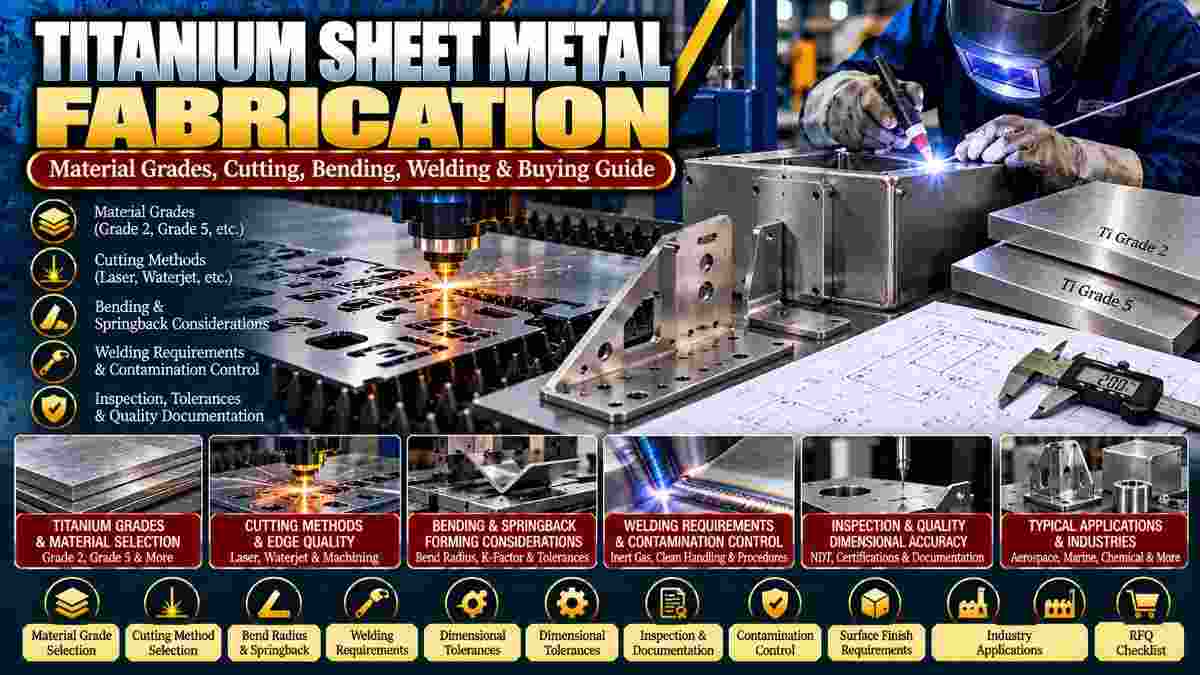
Are you sourcing titanium brackets, panels, heat exchanger components, or precision parts for demanding industrial applications? Titanium offers an excellent strength-to-weight ratio and corrosion resistance, but its fabrication requires careful planning.
Before outsourcing titanium sheet metal fabrication, engineers should verify material grade, sheet thickness, cutting requirements, bend feasibility, welding protection, dimensional tolerances, and inspection documentation.
Virwadia Industries offers titanium sheet cutting and component fabrication services in Chennai, India.
Titanium sheet metal fabrication involves cutting, forming, welding, and finishing titanium sheets into components that meet specified engineering requirements.
Common applications include:
Chemical processing equipment.
Aerospace components.
Marine equipment.
Heat exchanger parts.
Industrial brackets.
Corrosion-resistant panels.
Explore Titanium Sheet & Component Fabrication for service information.
Titanium grade selection depends on required strength, corrosion resistance, formability, operating conditions, and the applicable product specification.
Common options include:
Grade 2: Commercially pure titanium offering good formability and corrosion resistance.
Grade 5: Ti-6Al-4V alloy commonly selected for high-strength applications.
Grade 7: Palladium-alloyed titanium used for certain demanding corrosion environments.
Grade 23: Extra-low-interstitial Ti-6Al-4V used in selected medical and high-performance applications.
Do not assume different titanium grades are interchangeable.
Specify the applicable ASTM or other material standard.
Material certification helps verify titanium grade, chemical composition, product condition, and traceability.
Buyers should request documentation appropriate to the project, potentially including:
Material Test Certificates.
Heat or batch identification.
Chemical composition.
Mechanical test results.
Applicable material specifications.
Required inspection records.
Confirm documentation requirements before ordering.
Sheet thickness influences cutting feasibility, forming loads, bend geometry, welding requirements, and dimensional accuracy.
Important information includes:
Nominal thickness.
Permitted thickness variation.
Material condition.
Component geometry.
Required tolerances.
Thicker or higher-strength titanium may require different tooling and manufacturing methods.
Titanium cutting methods should be selected according to sheet thickness, part geometry, edge quality, heat sensitivity, and subsequent processing requirements.
Possible methods include:
CNC laser cutting.
Abrasive waterjet cutting.
Mechanical cutting.
Application-specific machining.
Laser cutting can produce complex profiles, but thermal effects and potential edge contamination must be controlled.
Waterjet cutting avoids a thermally generated heat-affected zone but introduces other considerations, including abrasive handling and edge finishing.
Explore Titanium Sheet Cutting for related services.
Titanium contamination control is essential because inappropriate handling and high-temperature exposure can affect surface integrity, weld quality, and material performance.
Good practices include:
Using clean handling equipment.
Avoiding contact with contaminated steel tools.
Removing grease and oil.
Keeping work areas clean.
Protecting prepared surfaces.
Following approved cleaning procedures.
Special attention is required when titanium components will be welded.
Titanium springback occurs when a formed component partially recovers elastically after bending force is removed.
Springback depends on:
Titanium grade.
Sheet thickness.
Bend radius.
Material condition.
Tooling geometry.
Forming temperature.
Incorrect compensation can cause inaccurate finished angles.
Trial bending and verified forming parameters help establish suitable settings.
The required bend radius should reflect titanium grade, thickness, material condition, and the intended forming process.
A radius suitable for commercially pure Grade 2 titanium may not be appropriate for stronger Grade 5 material.
Excessively tight bends can increase cracking risk.
Engineers should confirm bend feasibility before finalizing component drawings.
Titanium welding requires appropriate protection against atmospheric contamination while the weld and surrounding metal remain at elevated temperatures.
Depending on the approved welding procedure, protection may include:
High-quality inert shielding gas.
Trailing gas shields.
Backside purging.
Clean joint preparation.
Controlled filler materials.
Suitable inspection procedures.
Inadequate shielding can contribute to contamination, porosity, and embrittlement.
Titanium weld quality should be assessed against an approved welding procedure and the project's specified acceptance criteria.
Inspection may include:
Visual examination.
Weld profile inspection.
Dimensional checks.
Appropriate nondestructive testing.
Surface condition evaluation.
Required procedure documentation.
Weld discoloration can indicate shielding problems, but appearance alone does not establish complete weld integrity.
Dimensional tolerances should reflect the finished component's functional requirements and the capabilities of the intended fabrication process.
Important dimensions include:
Overall length and width.
Hole diameter.
Hole position.
Bend angles.
Formed flange dimensions.
Flatness.
Assembly interfaces.
Clearly identify critical dimensions on approved engineering drawings.
Material waste can be reduced through accurate drawings, suitable cutting layouts, practical design geometry, and careful handling.
Useful approaches include:
Verify dimensions before production.
Review sheet utilization.
Avoid unnecessary cutting complexity.
Confirm bend feasibility.
Approve prototypes when appropriate.
Inspect critical features early.
Material optimization must not compromise component quality.
Prices depend on titanium grade, sheet thickness, component complexity, cutting method, bending requirements, welding, inspection, and order quantity.
Additional factors include material certification, specialized handling, surface finishing, and packaging.
Compare quotations using identical technical requirements.
A complete titanium fabrication quotation request should identify the material, component geometry, manufacturing processes, inspection requirements, and delivery expectations.
Use this checklist:
Titanium grade and material standard.
Sheet thickness and condition.
Approved 2D and 3D drawings.
Required cutting process.
Bend angles and inside radii.
Welding requirements.
Critical dimensional tolerances.
Surface finish and cleanliness requirements.
Material certification.
Inspection and testing requirements.
Prototype or production quantity.
Delivery location and schedule.
Also clarify whether the supplier will provide the titanium material.
Virwadia Industries offers titanium sheet and component fabrication services for industrial projects in Chennai.
Its website lists titanium cutting, bending, welding, and precision component fabrication.
Explore Titanium Sheet & Component Fabrication and Titanium Sheet Cutting.
Confirm specific material grades, machine capabilities, welding procedures, inspection documentation, and availability before purchasing.
Common questions concern titanium grades, forming, cutting, welding, and quality control.
Yes. Suitable titanium sheets can be laser cut with appropriate process controls and edge-quality verification.
It can be, depending on the titanium grade and condition. Springback and formability require particular attention.
No. They have different mechanical properties and forming characteristics.
Conventional fusion welding of titanium generally requires suitable inert-gas shielding to prevent atmospheric contamination.
Material documentation should match the purchase order, applicable specification, and project quality requirements.
You can request a quotation by providing your titanium grade, sheet thickness, component drawings, fabrication requirements, tolerances, quantity, and inspection needs.
For critical applications, include material traceability and quality documentation requirements.
Explore Titanium Sheet & Component Fabrication or contact Virwadia Industries to discuss your project.
Technical Note: Final fabrication methods, bend parameters, welding procedures, and inspection criteria should follow the approved material specifications and project engineering requirements.