
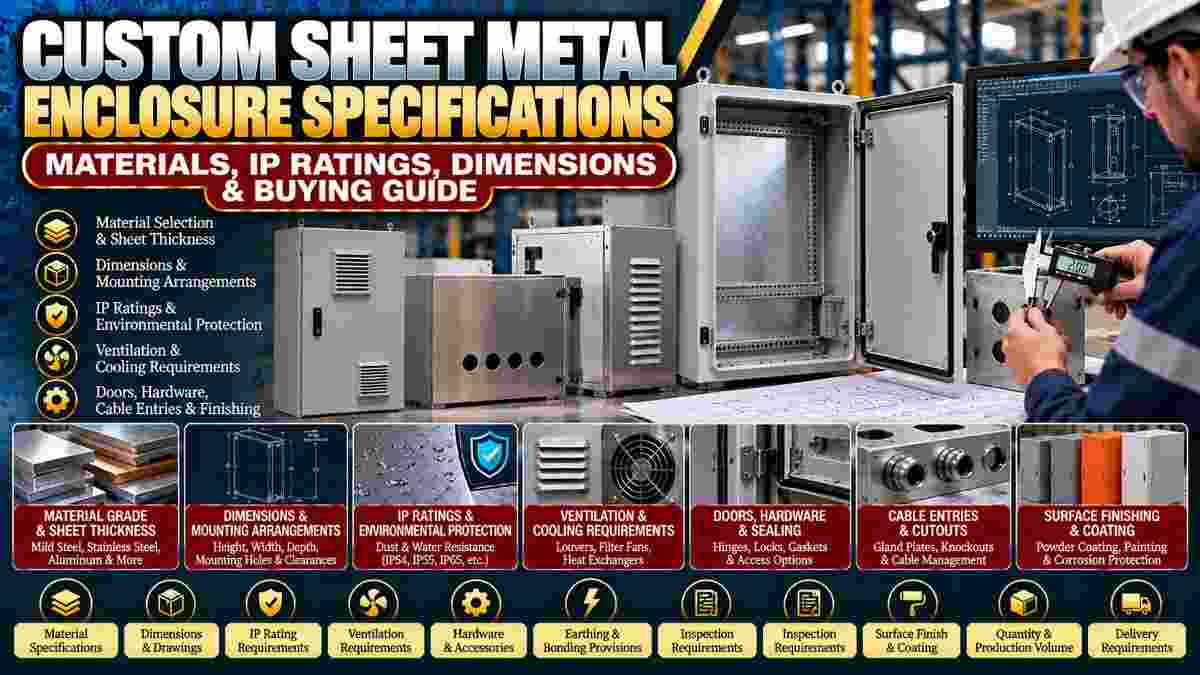
Are you sourcing electrical control panel cabinets, automation enclosures, or industrial equipment housings? Incomplete specifications can lead to installation problems, inadequate protection, and expensive fabrication modifications.
Custom sheet metal enclosure specifications should include dimensions, material grade, sheet thickness, mounting arrangements, doors, cable entries, ventilation, surface finishing, and required ingress protection.
Virwadia Industries provides industrial panel, bracket, and enclosure fabrication services in Chennai, India.
Custom sheet metal electrical enclosures are fabricated metal housings designed to contain and protect electrical or electronic equipment.
Common applications include:
Industrial control panels.
Automation cabinets.
Distribution equipment.
Machine control housings.
Instrumentation panels.
Electrical junction boxes.
Explore Industrial Panels, Brackets & Enclosures Fabrication for related services.
Detailed specifications help fabricators manufacture an enclosure that fits the equipment, installation space, and operating environment.
Missing information may cause incorrect dimensions, poorly positioned openings, inadequate mounting clearances, or unsuitable finishing.
Approved drawings should establish the required design before manufacturing.
Material selection depends on corrosion exposure, structural requirements, weight, conductivity, and environmental conditions.
Common choices include:
Mild steel: Often selected for indoor cabinets with suitable protective coatings.
Stainless steel: Considered for corrosive or hygiene-sensitive environments.
Aluminum: Useful where lower weight and suitable corrosion resistance are priorities.
Specify the exact metal grade rather than requesting only a steel enclosure.
Sheet thickness should be selected according to enclosure size, mechanical loading, mounting requirements, and structural stiffness.
Important considerations include door weight, equipment mounting loads, reinforcement, and transportation conditions.
Thicker material does not automatically eliminate the need for proper supports or stiffeners.
Confirm the final thickness through design evaluation.
Enclosure drawings should identify overall dimensions and the positions of all functional features.
Include:
Height, width, and depth.
Usable internal clearance.
Door dimensions.
Mounting plate dimensions.
Hole locations.
Cable entry positions.
Hinge and lock locations.
Wall or floor mounting details.
Use consistent measurement units and clearly identify critical tolerances.
The required IP rating depends on exposure to dust, water, and other environmental conditions.
IEC 60529 defines ingress protection classifications.
For example:
IP54: Limited dust ingress and protection against water splashes under specified test conditions.
IP55: Limited dust ingress and protection against water jets under specified test conditions.
IP65: Dust-tight protection and resistance to water jets under specified test conditions.
These ratings apply only when the completed enclosure meets the relevant requirements.
Gaskets, joints, cable glands, ventilation openings, and installation details can affect performance.
Doors and hardware must provide suitable access while maintaining mechanical security and the required enclosure protection.
Specify:
Door opening direction.
Hinge type.
Locking arrangement.
Door gasket requirements.
Removable panel requirements.
Maintenance accessibility.
Large doors may require additional reinforcement.
Cable entries should accommodate the planned cable routes while preserving clearance, protection, and installation access.
Important details include:
Cable entry location.
Gland plate dimensions.
Cable diameter range.
Required gland types.
Conduit connections.
Cable bend clearance.
Unapproved drilling or cutting after fabrication can compromise enclosure protection.
Ventilation and cooling requirements should be based on internal heat generation, ambient temperature, and allowable equipment temperatures.
Possible arrangements include:
Passive ventilation.
Filtered fans.
Heat exchangers.
Enclosure cooling units.
Ventilation openings must be compatible with the required environmental protection.
Thermal performance should be evaluated for the complete electrical assembly.
Appropriate earthing and protective bonding provisions support electrical safety when conductive enclosures contain electrical equipment.
Design requirements may include:
Dedicated earthing studs.
Door bonding provisions.
Protective conductor connections.
Accessible bonding points.
The electrical designer should establish these requirements under the applicable equipment standards.
The fabricator should manufacture the approved features accurately.
Surface finishing should be selected according to corrosion exposure, appearance, durability, and intended service conditions.
Common options include:
Powder coating.
Wet painting.
Suitable galvanized finishes.
Stainless steel brushing or polishing.
Specify color, finish, coating requirements, and areas that must remain suitable for electrical contact.
Enclosure inspection should verify dimensions, fit, workmanship, surface finish, and required functional features.
Check:
Overall dimensions.
Mounting hole positions.
Door alignment.
Weld quality.
Sharp edges and burrs.
Gasket installation.
Surface finishing.
Hardware operation.
Bonding provisions.
Required inspection documentation.
Ingress protection testing should be specified separately where required.
Fabrication prices depend on material, dimensions, thickness, design complexity, finishing, hardware, and production quantity.
Additional costs may arise from specialized welding, seals, inspection, packaging, and assembly requirements.
Compare quotations using identical specifications.
A complete RFQ should describe the enclosure design, materials, protection requirements, manufacturing scope, and quantity.
Provide:
Approved 2D and 3D drawings.
Material grade and thickness.
Overall and internal dimensions.
Required IP rating and test documentation.
Door, hinge, and lock details.
Mounting arrangements.
Cable entry and gland plate details.
Ventilation and cooling provisions.
Earthing and bonding features.
Surface finish requirements.
Inspection and acceptance criteria.
Quantity and delivery location.
Clearly state whether the order covers an empty fabricated enclosure or a fully assembled electrical panel.
Virwadia Industries provides industrial sheet metal fabrication services, including panels, brackets, and enclosures.
Its services include CNC cutting, bending, welding, and component fabrication.
Explore Industrial Panels, Brackets & Enclosures Fabrication for service information.
Confirm material availability, manufacturing capabilities, inspection requirements, and project scope before ordering.
Buyers commonly ask about materials, ingress protection, customization, and fabrication requirements.
Yes. Dimensions and mounting features can be manufactured according to approved designs and supplier capabilities.
It can be suitable when the selected grade, construction, sealing, and finish meet the actual environmental requirements.
No. Water ingress protection depends on the complete enclosure design and tested configuration.
Yes. Ventilation or cooling arrangements can be incorporated when compatible with the required protection and thermal design.
Yes. Cutouts and gland plates can be included according to approved drawings.
You can request a fabrication quotation by sharing your enclosure drawings, material specifications, dimensions, protection requirements, quantity, and delivery expectations.
Explore Industrial Panels, Brackets & Enclosures Fabrication or contact Virwadia Industries to discuss your requirements.
Technical Note: Final enclosure design should follow applicable electrical safety standards, environmental requirements, approved engineering drawings, and specified inspection procedures.