Are you planning to outsource laser cutting for stainless steel, mild steel, aluminum, or industrial sheet metal components? Sending incomplete drawings or material details can lead to inaccurate quotations, manufacturing delays, and unexpected costs.
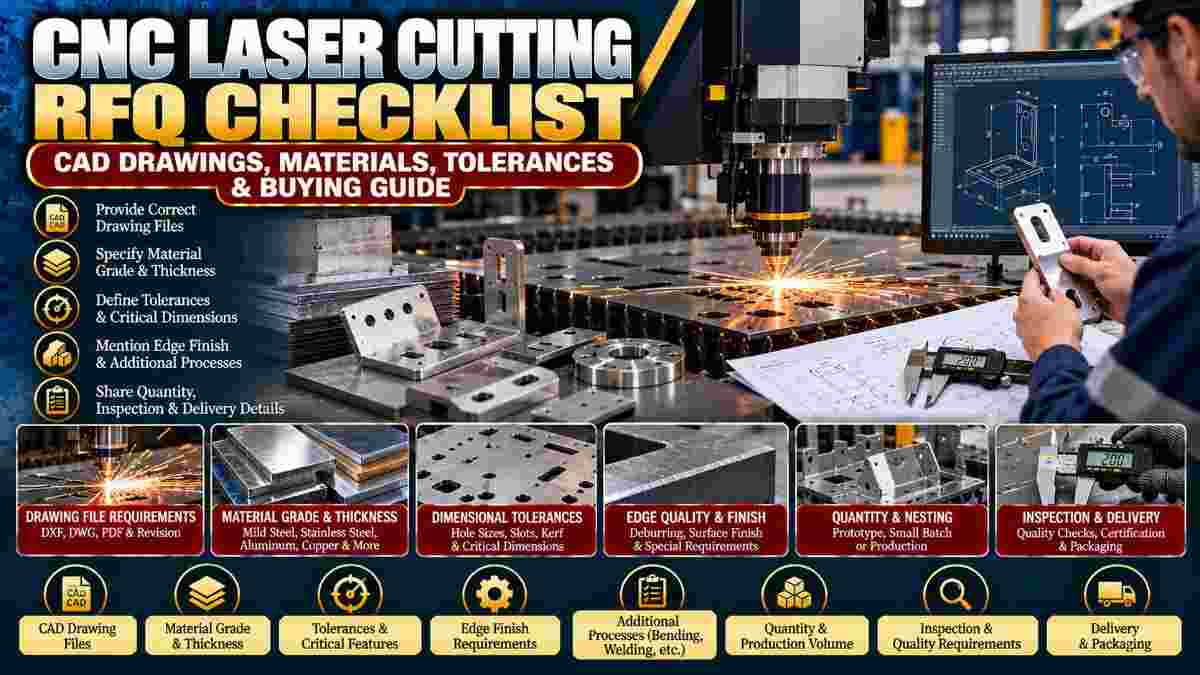
A CNC laser cutting RFQ should include CAD drawings, material grade, sheet thickness, part dimensions, tolerances, edge-finish requirements, quantities, and delivery expectations.
Providing complete specifications helps manufacturers evaluate cutting feasibility and prepare accurate quotations.
Virwadia Industries offers CNC cutting and sheet metal fabrication services in Chennai, India.
CNC laser cutting job work is an outsourced manufacturing service that uses a computer-controlled laser beam to cut specified profiles from suitable materials.
Common applications include:
Industrial brackets.
Machine components.
Electrical panels.
Metal enclosures.
Automotive components.
Sheet metal blanks.
Custom fabrication parts.
Explore CNC Cutting Job Work for service information.
A detailed RFQ helps suppliers understand the material, component geometry, quality requirements, and scope of work before providing a quotation.
Incomplete specifications may cause incorrect pricing, production delays, material wastage, and dimensional problems.
Clear requirements also make it easier to compare supplier quotations.
DXF and DWG are commonly used for 2D laser cutting profiles, while PDF drawings help communicate dimensions, tolerances, and manufacturing notes.
Depending on supplier requirements, useful files include:
DXF cutting profiles.
DWG drawings.
STEP models for related fabrication work.
Dimensioned PDF drawings.
Provide the latest approved file revision and confirm that the units and scale are correct.
Laser cutting drawings should contain accurate, closed cutting profiles without unnecessary duplicate lines or overlapping geometry.
Before sending files:
Check the drawing scale.
Remove duplicate contours.
Close open profiles.
Identify internal cutouts.
Separate engraving from cutting.
Confirm measurement units.
Label each part.
Include the drawing revision.
Clean CAD files help reduce programming errors.
Material grade influences laser cutting parameters, edge quality, processing time, and material cost.
Common materials include:
Mild steel.
Stainless steel.
Aluminum.
Copper.
Other suitable engineering metals.
Instead of requesting only “stainless steel cutting,” specify the required grade, such as 304 or 316L, where applicable.
Explore Sheet Metal Cutting for related services.
Sheet thickness affects cutting speed, achievable feature sizes, edge characteristics, and manufacturing feasibility.
Your RFQ should identify:
Nominal sheet thickness.
Material grade.
Required dimensions.
Quantity.
Any material certification requirements.
Maximum cutting thickness varies by machine, material, and quality requirements.
Confirm actual capacity with the supplier before ordering.
Dimensional tolerances should reflect the component's functional requirements rather than applying unnecessarily tight limits to every feature.
Identify critical dimensions such as:
Overall part size.
Hole diameter.
Hole position.
Slot width.
Profile accuracy.
Flatness requirements.
Tighter tolerances may require additional processing or inspection.
Agree on achievable tolerances before production.
Kerf is the width of material removed by the laser, and its size can influence narrow slots, small holes, and closely spaced features.
Modern cutting software compensates for kerf where appropriate.
However, buyers should still identify:
Small holes.
Narrow slots.
Thin internal features.
Minimum edge distances.
Critical corner geometry.
Manufacturing feasibility depends on material thickness and machine capability.
Edge-finish requirements should identify whether standard laser-cut edges are acceptable or additional finishing operations are necessary.
Possible requirements include:
Burr removal.
Deburring.
Edge smoothing.
Surface protection.
Scratch prevention.
Post-cut cleaning.
Specify whether edges will remain visible or require further welding, bending, or assembly.
Production quantity and sheet nesting affect material utilization, setup costs, cutting time, and overall quotation value.
Provide quantities for every component.
Where applicable, identify whether the order is for:
Prototype parts.
Trial production.
Small batches.
Repeat production.
Large-volume manufacturing.
Let the supplier confirm the suitable nesting arrangement and material usage.
Yes. Buyers should identify any bending, welding, drilling, tapping, coating, or assembly required after laser cutting.
Separate fabrication instructions help clarify the quotation scope.
For example, a laser-cut bracket that requires bending should include the final formed dimensions and relevant bend specifications.
Confirm whether additional operations are included or quoted separately.
Inspection requirements should identify critical dimensions, acceptable defects, and any documentation required before delivery.
Possible requirements include:
Dimensional inspection.
First-article inspection.
Hole-position verification.
Edge-quality checks.
Material identification.
Inspection reports.
Specify the appropriate acceptance criteria before manufacturing begins.
Laser cutting prices depend on material, thickness, cutting complexity, processing time, quantity, and additional finishing requirements.
Other factors include setup work, material procurement, inspection, packaging, and transportation.
Compare quotations based on the complete scope rather than unit price alone.
A complete quotation request should contain the technical, quality, quantity, and commercial information required to manufacture the parts.
Include:
Component name and drawing number.
Approved DXF or DWG file.
Dimensioned PDF drawing.
Material grade.
Sheet thickness.
Part dimensions.
Critical tolerances.
Required hole and slot sizes.
Edge-finish requirements.
Additional fabrication operations.
Quantity per component.
Inspection and certification requirements.
Raw material supply responsibility.
Packaging and delivery requirements.
Virwadia Industries offers CNC cutting, sheet metal cutting, bending, welding, and fabrication services for industrial applications.
Its Chennai-based operations support metal component manufacturing requirements.
Explore CNC Cutting Job Work and Sheet Metal Cutting.
Confirm available materials, cutting capacities, tolerances, and production schedules before placing an order.
Industrial buyers commonly ask about CAD files, material thickness, accuracy, and quotation requirements.
Yes, preliminary evaluation may be possible using dimensioned drawings, but an accurate CAD file is recommended.
Yes. Thickness affects machine settings, cutting time, and processing requirements.
Yes, within the equipment's capabilities and the limits imposed by material, thickness, and feature geometry.
Yes. Critical tolerances should be clearly identified in the approved drawing.
Yes. Laser cutting can be combined with suitable bending, welding, and other fabrication processes.
You can request a quotation by sharing your drawings, material grade, thickness, required quantity, tolerances, and delivery location.
For complex components, include additional inspection and fabrication requirements.
Explore CNC Cutting Job Work or contact Virwadia Industries to discuss your project.
Technical Note: Final manufacturing feasibility, cutting capacity, dimensional accuracy, and delivery conditions should be confirmed against approved drawings and the supplier's actual machine capabilities.